Modern vehicles are becoming remarkably good at understanding what is happening around them. A new car may recognize lane markings, detect a pedestrian entering a crosswalk, monitor vehicles hidden in a blind spot, measure the distance to traffic ahead, and warn a driver about a potential collision. None of this would be possible without automotive sensors.
In 2026, cameras, radar, LiDAR, ultrasonic sensors, and increasingly sophisticated software work together to give vehicles a digital picture of the road. These technologies are essential to advanced driver-assistance systems, commonly known as ADAS, and they are becoming increasingly important as manufacturers develop more automated driving functions.
The National Highway Traffic Safety Administration provides information about driver-assistance technologies such as automatic emergency braking, lane assistance, and blind-spot intervention. Behind many of these features is a network of sensors continuously gathering information.
Sensor technology also connects directly with the growth of artificial intelligence in vehicles. Our guide to In-Car AI Copilots in 2026 explores another part of the rapidly evolving relationship between software, AI, and modern driving.
Why Modern Cars Need Multiple Types of Sensors
No single sensor can perfectly understand every road condition. Cameras are excellent at recognizing visual details, but their effectiveness can be affected by darkness, glare, rain, fog, or obscured lenses. Radar can measure distance and relative speed effectively, but traditional radar may provide less visual detail than a camera. LiDAR creates highly detailed three-dimensional measurements, yet it comes with its own cost, packaging, and environmental considerations.
Automakers therefore combine multiple technologies. One sensor can provide information that another may struggle to detect. The vehicle’s software then compares and combines those inputs to build a more reliable picture of its surroundings.
This approach is often called sensor fusion. It plays an increasingly important role in modern vehicle safety features because automated systems need dependable information before deciding whether to issue a warning, apply the brakes, or assist with steering.
How Automotive Cameras Work
Cameras are among the most familiar automotive sensors. They may be mounted near the windshield, inside exterior mirrors, around the bumpers, or elsewhere on the vehicle. Some cars use several cameras to create a nearly complete view around the vehicle.
Computer vision software analyzes the images produced by these cameras. Depending on the system, cameras may help identify lane markings, traffic signs, other vehicles, pedestrians, cyclists, traffic lights, and road boundaries.
Why Cameras Are Important
Cameras provide something other sensors cannot easily duplicate: rich visual information. A camera can distinguish between objects based on shape, color, markings, and context. That makes cameras particularly useful for understanding traffic signs and road markings.
For example, radar may detect that an object exists ahead, while a camera can help software determine whether that object is a car, pedestrian, bicycle, or traffic cone.
However, cameras are not perfect. Bright sunlight, darkness, snow, heavy rain, dirt, condensation, or a blocked lens can reduce image quality. This is one reason drivers should keep sensor and camera areas clean when maintaining their vehicles. Our Essential Car Maintenance Tips Every Driver Should Know guide covers broader maintenance habits that can help keep a modern vehicle operating properly.
How Automotive Radar Works
Radar uses radio waves to detect objects and measure their distance and movement relative to the vehicle. Automotive radar units are commonly installed behind bumpers, grilles, body panels, or other carefully selected locations.
Radar is particularly useful for determining how far away another vehicle is and how quickly the distance between the two vehicles is changing. This makes it valuable for adaptive cruise control, forward collision warnings, blind-spot monitoring, and other driver-assistance features.
Why Radar Performs Well in Difficult Conditions
One advantage of radar is its ability to operate in conditions where a camera may have more difficulty. Radar does not depend on visible light in the same way a conventional camera does, allowing it to provide useful measurements at night and in some poor-weather situations.
Modern radar technology is becoming increasingly sophisticated. Higher-resolution systems can provide a more detailed understanding of surrounding objects, giving vehicle software additional information about road users and obstacles.
The SAE International automotive engineering community regularly covers advances in radar, LiDAR, cameras, ADAS, and automated-driving technologies as these sensing systems continue to evolve.
How LiDAR Works in Modern Cars
LiDAR stands for Light Detection and Ranging. Instead of radio waves, LiDAR uses light to measure the distance between the sensor and surrounding objects. The system sends out light pulses and measures how long they take to return after reflecting from an object.
By repeating this process extremely quickly, LiDAR can create a detailed three-dimensional representation of the vehicle’s surroundings. The resulting data can show road edges, vehicles, pedestrians, buildings, barriers, and other objects with precise distance information.
Why LiDAR Is Getting More Attention
 LiDAR has long been associated with experimental autonomous vehicles carrying large spinning sensors on their roofs. The technology is changing, however. Newer units can be considerably smaller and are increasingly designed for integration into roofs, grilles, windshields, headlamps, or body panels.
As the technology matures, manufacturers and suppliers are working to reduce cost while improving range, resolution, reliability, and packaging. This is helping LiDAR move beyond research vehicles and into selected production vehicles with advanced assistance systems.
LiDAR does not automatically make a vehicle autonomous. It is simply another source of perception data. The software still needs to interpret what the sensor detects and determine how the vehicle should respond.
What Are Ultrasonic Sensors?
Not every automotive sensor is designed for detecting objects hundreds of feet away. Ultrasonic sensors specialize in short-distance detection and have been common in vehicles for years.
These small sensors are frequently visible as circular elements embedded in front and rear bumpers. They use sound waves to detect nearby objects and estimate distance.
Ultrasonic sensors are especially helpful during low-speed maneuvers. Parking assistance systems may use them to warn drivers about walls, posts, curbs, or nearby vehicles. Some automated parking systems also combine ultrasonic sensors with cameras and other technologies.
Why Sensor Fusion Matters
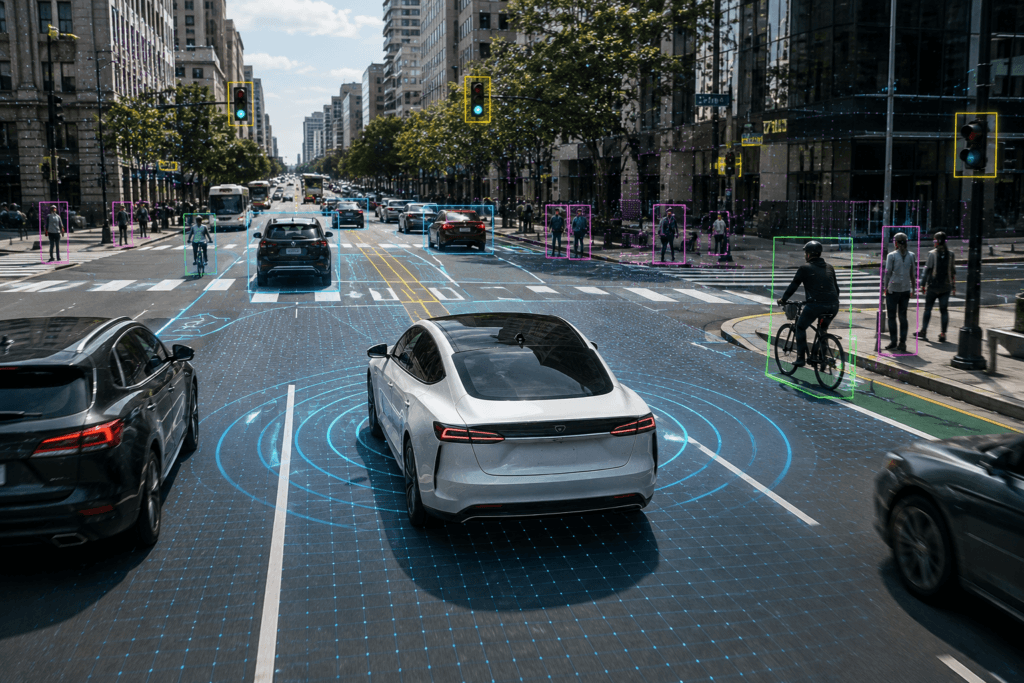
The real power of modern automotive sensing comes from combining information rather than relying on one sensor alone. Sensor fusion software takes inputs from cameras, radar, LiDAR, ultrasonic sensors, GPS, and other sources and turns them into a unified understanding of the environment.
Imagine a vehicle traveling along a highway. Radar detects an object ahead and determines that the distance is closing. A camera identifies the object as another vehicle and recognizes the lane markings around it. LiDAR may provide additional three-dimensional distance information. Software then combines those measurements before an ADAS feature decides whether action is necessary.
This process happens continuously while the vehicle is moving. More data does not automatically mean better driving assistance; the vehicle also needs enough computing power and well-designed software to interpret that information accurately.
That software-driven approach is part of the same evolution discussed in our article on AI in the Automotive Industry. Increasingly, modern automotive performance depends as much on software and processing as it does on traditional mechanical engineering.
How Sensors Support ADAS Features
Drivers may interact with sensor technology every day without realizing it. Sensors provide input for many familiar driver-assistance systems.
Automatic Emergency Braking
Forward-facing sensors can identify a potential collision with another vehicle or, depending on the system, certain pedestrians and cyclists. The vehicle may warn the driver and automatically apply braking if necessary.
The Insurance Institute for Highway Safety provides information and research about advanced driver-assistance systems and crash-avoidance technologies.
Adaptive Cruise Control
Adaptive cruise control monitors traffic ahead and adjusts vehicle speed to maintain a selected following distance. Radar is commonly associated with this function, although implementations vary among manufacturers.
Blind-Spot Monitoring
Sensors positioned around the vehicle can monitor neighboring lanes and alert the driver when another vehicle enters a blind area. More advanced systems may also provide steering assistance if the driver begins moving toward an occupied lane.
Lane Assistance
Forward-facing cameras can identify lane markings and determine the vehicle’s position within a lane. Depending on the system, the vehicle may warn the driver of an unintended departure or provide steering assistance.
Sensors and Connected Cars
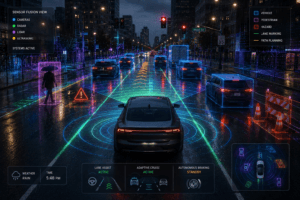 Sensors help a vehicle understand its immediate physical surroundings, while connectivity can provide information from beyond the range of onboard sensing. Together, these technologies may give future vehicles a broader understanding of road conditions.
For example, a connected system could receive information about a hazard farther along the route while cameras and radar continue monitoring nearby traffic. This complements technologies discussed in our Connected Cars in 2026 article.
Vehicles may also receive improvements to their sensing and perception software through wireless updates. Our guide to over-the-air vehicle updates explains why software updates are becoming a normal part of modern car ownership.
What Happens When Sensors Get Dirty or Damaged?
Advanced sensors still depend on physical hardware mounted somewhere on the vehicle. Mud, snow, ice, road salt, damage, incorrect replacement parts, or poor repairs can interfere with sensor performance.
A damaged bumper, for example, may affect a radar unit mounted behind it. Windshield replacement can also be important on vehicles with cameras positioned near the rearview mirror.
Some repairs require sensor calibration so the system correctly understands its position and surroundings. Drivers should follow manufacturer procedures after repairs involving cameras, radar units, windshields, suspension components, or related areas.
Can Drivers Completely Rely on Automotive Sensors?
No. Driver-assistance sensors are designed to support the driver, not eliminate the need for attention unless the vehicle is specifically operating under an automated-driving system that permits otherwise.
Weather, road design, damaged markings, blocked sensors, unusual objects, software limitations, and other factors can affect performance. Drivers should understand the capabilities and limitations described in their vehicle owner’s manual.
This distinction is particularly important as advanced systems become more capable. Sophisticated technology can make driving easier, but drivers should not assume that a vehicle can handle situations beyond what the manufacturer specifies.
The Future of Automotive Sensor Technology
Automotive sensing is likely to continue developing rapidly. LiDAR systems are becoming smaller, radar resolution is improving, cameras are gaining better image quality, and software is becoming more capable of combining enormous amounts of sensor information.
Future vehicles may also use additional sensing technologies, including thermal cameras and newer radar architectures, depending on the application. The challenge will not simply be adding more hardware. Automakers must determine which combination of sensors provides useful redundancy, reliable performance, manageable cost, and appropriate computing requirements.
As vehicles become increasingly software-defined, perception systems may also improve after purchase. New algorithms can potentially refine object detection and other capabilities through carefully validated software updates. That makes cybersecurity important as well, since software controlling connected sensor systems must remain protected. Our article on Vehicle Cybersecurity in Connected Cars explains why digital security has become an important part of automotive engineering.
What Drivers Should Know When Buying a New Car
When comparing vehicles, drivers should look beyond marketing terms and understand exactly what each assistance feature does. Two cars may advertise similar technology while using different sensors, operating conditions, or driver-monitoring requirements.
Ask whether the vehicle includes automatic emergency braking, adaptive cruise control, blind-spot monitoring, lane assistance, parking sensors, or surround-view cameras. More importantly, learn the limitations of each feature.
Drivers should also consider repair costs. Advanced cameras and sensors can make windshield, bumper, and body repairs more complicated because calibration may be necessary afterward.
Final Thoughts
LiDAR, radar, cameras, and other automotive sensors are giving modern cars an increasingly detailed understanding of the road. Each technology has different strengths, which is why manufacturers often combine several sensors rather than relying on only one.
Cameras provide rich visual information, radar measures distance and movement effectively, LiDAR can create detailed three-dimensional maps, and ultrasonic sensors remain useful for close-range detection. Sensor-fusion software brings these inputs together so driver-assistance systems can make better-informed decisions.
For drivers, the most important point is that these technologies are assistance tools. They can improve awareness and support safety, but their effectiveness depends on proper maintenance, calibration, software, road conditions, and responsible use. As automotive sensors continue to improve through 2026 and beyond, they will remain one of the most important technologies shaping smarter and increasingly capable vehicles.